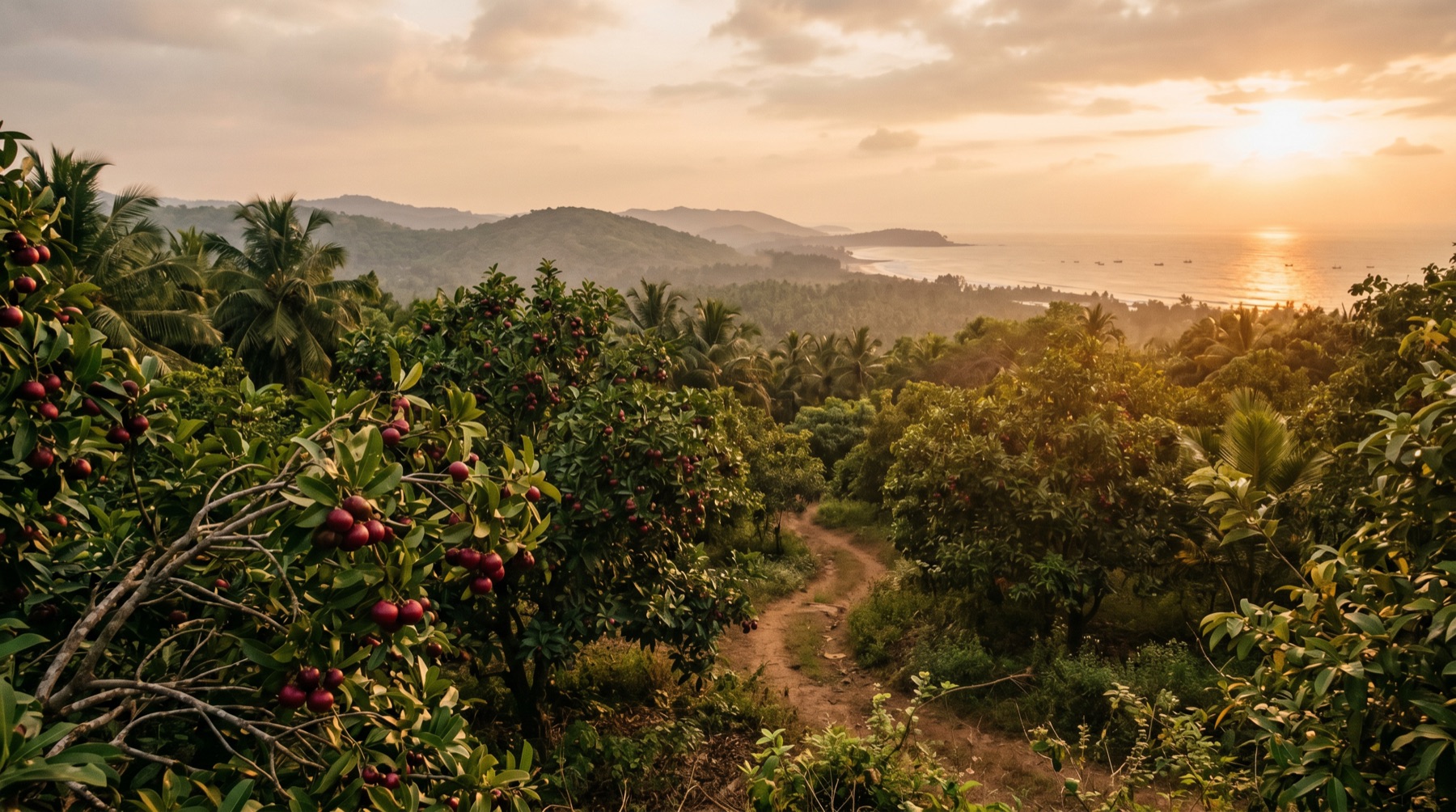
We publish the shortest supply chain we honestly can. Fruit to press to fraction to pallet — five stages, one coast, one factory.
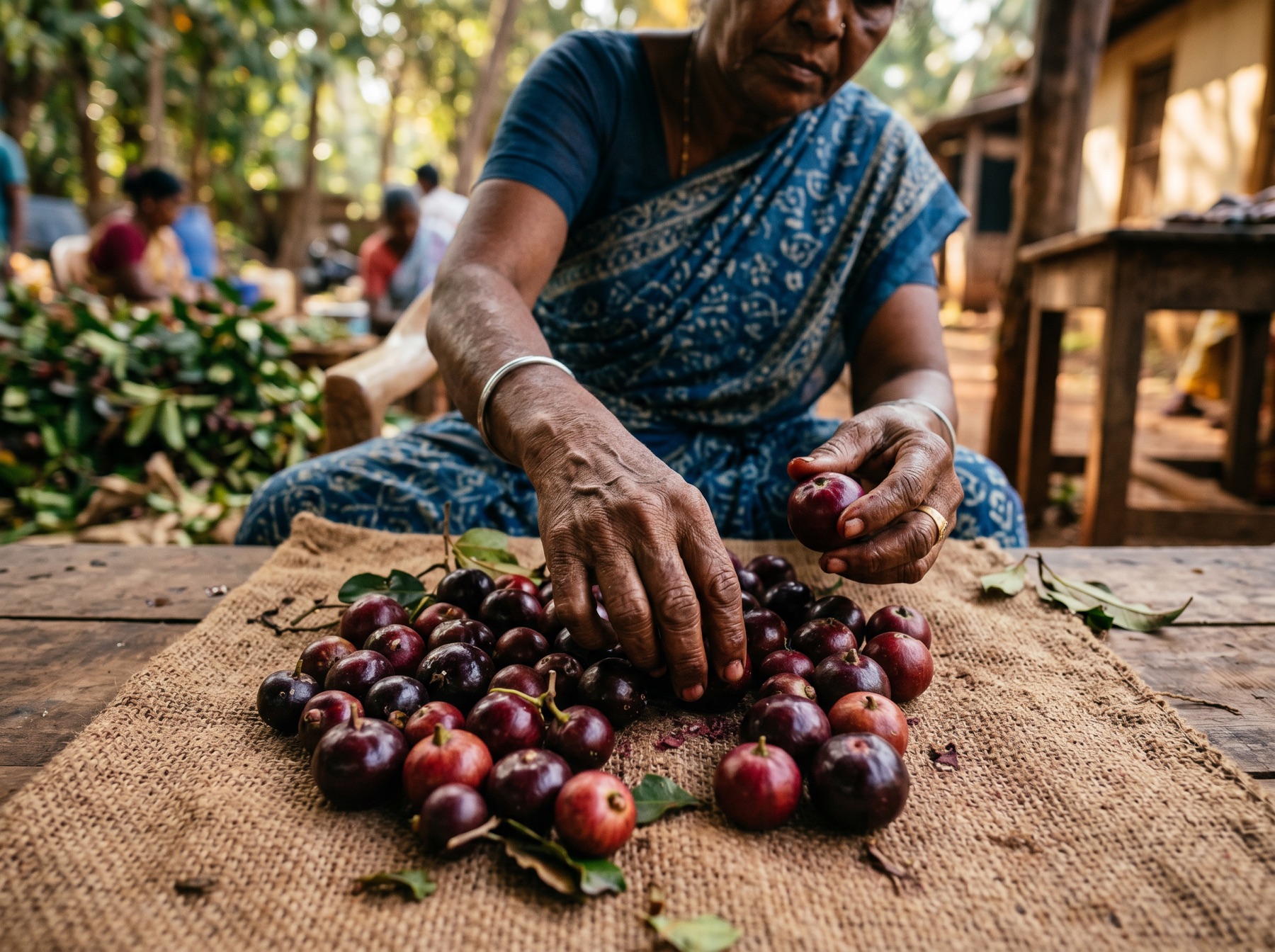
Fruit is sourced from eleven named co-operatives across Sindhudurg, Ratnagiri, and the southern Konkan belt. Every co-operative is registered with us by panchayat, contact person, and average annual yield. Harvest windows are published: kokum runs 5 May to 21 June, mango kernel runs 10 May to 30 July. Nothing is bought outside those windows.
Kernels are hand-sorted at the co-operative before they travel to the press. We train each grader against a reference sheet: moisture below 8%, visible mould at 0%, foreign matter below 0.5%. Rejected kernels go back to the panchayat — we do not blend them into lower grades.
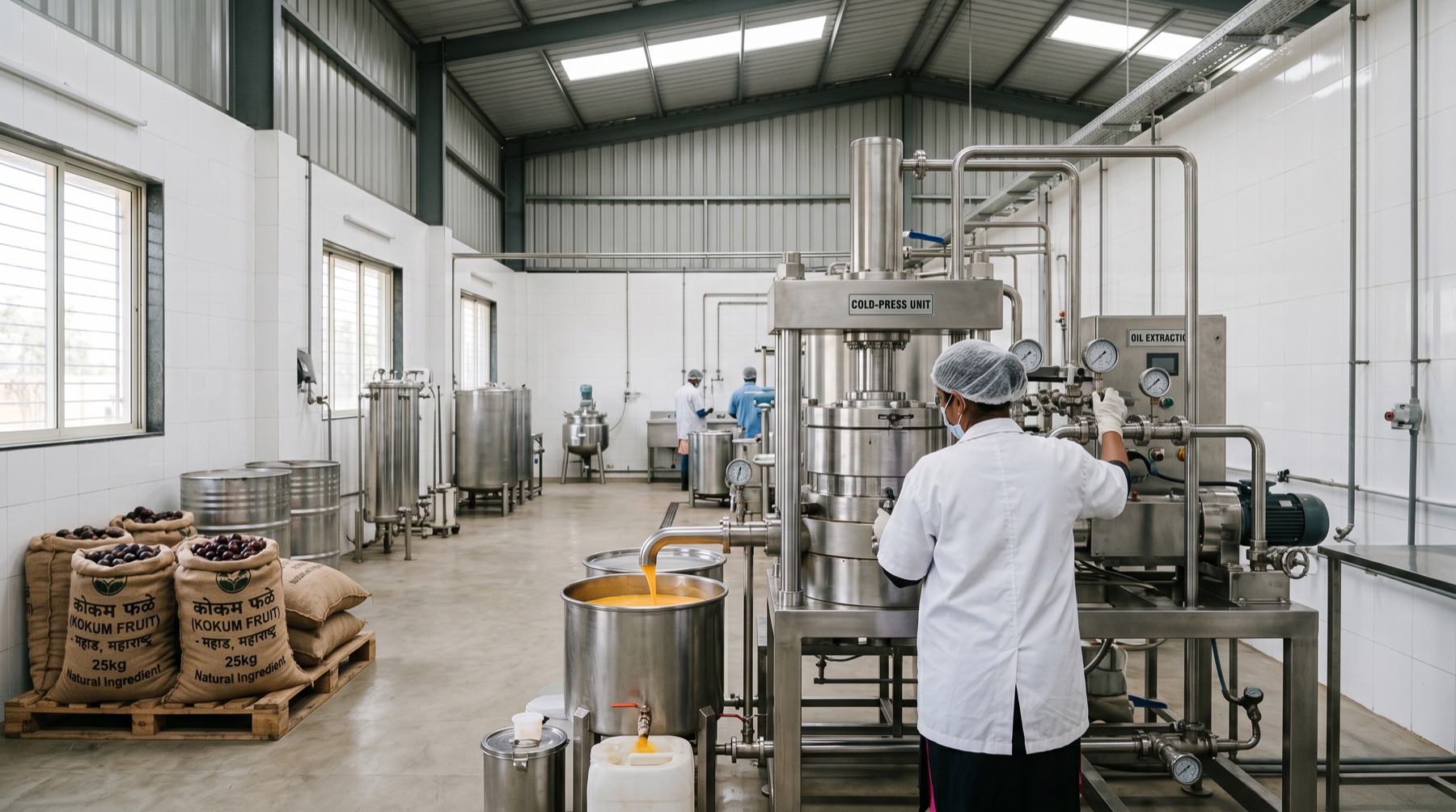
Our Chiplun facility runs two cold-press lines dedicated to kokum and mango kernel, plus a dedicated sal line blended in by volume. Temperature stays below 55°C through every step. No hexane. No bleaching for unrefined grades. The refined grades use physical refinement only — activated earth and steam, never solvents. Crude yield on kokum runs 43–47 percent, well above the 28–35 percent industry average for mechanical press alone.
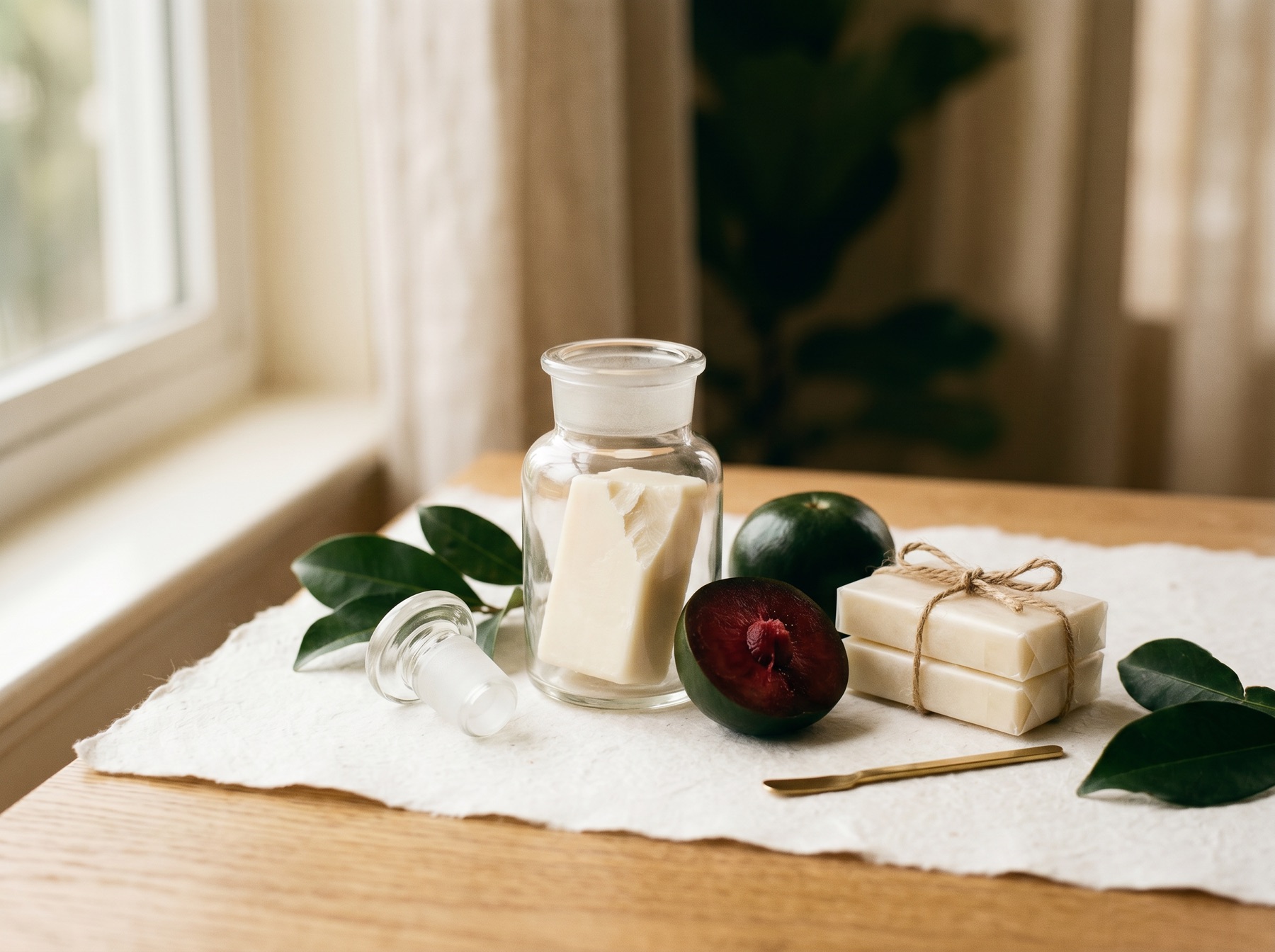
Kokum, mango kernel, and sal butters are split into a hard stearin fraction and a soft olein fraction by controlled crystallisation — no solvents, no hydrogenation. Temperature is ramped down from 42°C to 28°C over a six-hour window, the crystal mass is separated under filter press, and each fraction is tested on its own. The stearin carries the structural fats buyers use in CBE blends; the olein carries the light esters cosmetic formulators want. One butter becomes two commercial products, both lot-numbered.
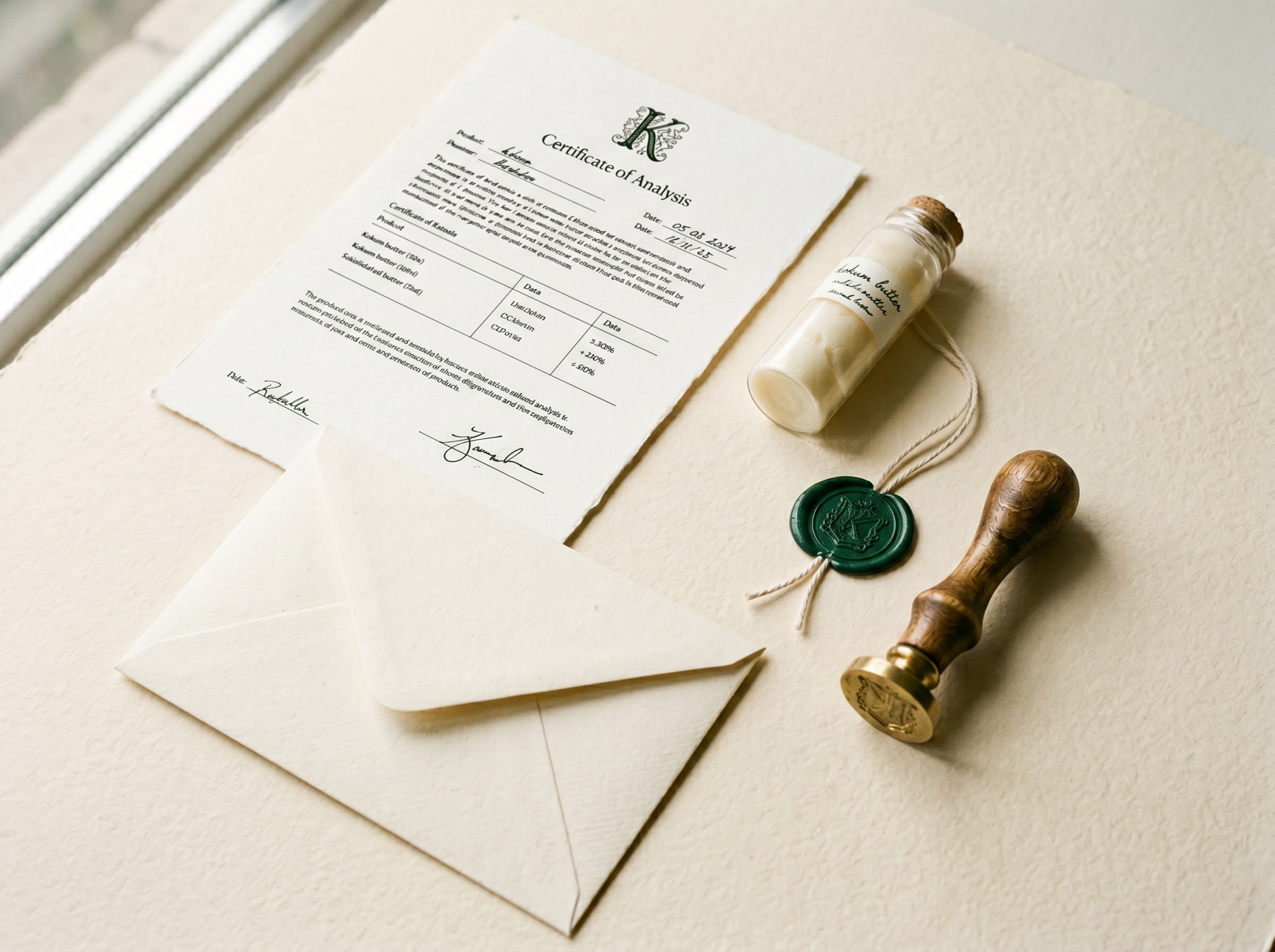
Every lot is numbered, tested, and accompanied by a Certificate of Analysis: fatty acid profile, SAP, iodine value, peroxide value, microbial counts. The CoA ships with every pallet and is available via our customer portal within 24 hours of press completion. We maintain a retained sample for each lot for 36 months in sealed amber glass.
Every qualified buyer receives these on request. We do not publish them openly — competitive reasons — but no inquiry is too small.
Fatty-acid, SAP, iodine, microbial — with lot & date.
Supplier paperwork and third-party certificates forwarded on request.
Safety data sheet & allergen declaration.
Chiplun facility visits scheduled by appointment.
A facility that processes peanut cannot honestly call itself a single-origin tree-butter house. We never have, and we never will. Here is the formal list.
Precision Organics manufactures natural fats and oils from a defined set of tree-borne seed and kernel sources: kokum (Garcinia indica), mango (Mangifera indica) kernel, sal (Shorea robusta), mahua (Madhuca longifolia), dhupa (Vateria indica) seed, and imported shea (Vitellaria paradoxa). No other seed, nut, oilseed, grain, legume, dairy, egg, or animal-derived material is processed in this facility at any time.
This is not a marketing claim. It is the line that separates us from a commodity press.
Explicitly excluded — facility-wide, for the life of the plant:
Supplier onboarding. Every raw-material vendor signs an Allergen Declaration Form affirming that the source botanicals are not processed alongside excluded allergens at the farm or primary processing site. Failure to sign terminates the supplier relationship.
Facility controls. The site perimeter gate log excludes any incoming material not on the approved list. Cleaning-in-place is validated quarterly for ATP residue and, where applicable, allergen-specific ELISA.
Cross-contamination statement on every label. Manufactured in a facility that processes kokum, mango kernel, sal, mahua, dhupa seed, and shea butter. This facility is peanut-free, tree-nut-free (beyond named sources), soy-free, sesame-free, gluten-free, dairy-free, and egg-free.
Tejas Dudhade
Founder & Managing Director · Precision Organics Pvt Ltd
A kilogram with a name.
From Konkan with love.